Write-up
Symbaloo
Tile-based start page organizing bookmarks and apps into a visual grid.
Symbaloo turns bookmarks into a grid of tiles you can set as your browser homepage. Here is what the free tier costs in ads, and who it is really built for.
At a glance
- Type: hosted, tile based start page for organizing bookmarks into a visual grid (symbaloo.com, read 2026-09-29)
- Pricing: free with advertising, or Personal Premium at $34.95 a year ($4.49 a month) to remove ads (symbaloo.com/plans, read 2026-09-29)
- License: closed source. Symbaloo does not publish a repository or a stated license.
- Install: sign up on the web, plus optional browser extensions for Chrome, Firefox and Edge (symbaloo.com, blog.symbaloo.com, read 2026-09-29)
- Platforms: any browser as a web sign-in, with dedicated extensions for Chrome, Firefox and Edge, and an installable PWA manifest for adding it as an app
- Links: symbaloo.com · Plans · Blog
- Paid plans from
- $34.95 USD, checked (source)
Last checked
Screenshots
What it is and who it's for
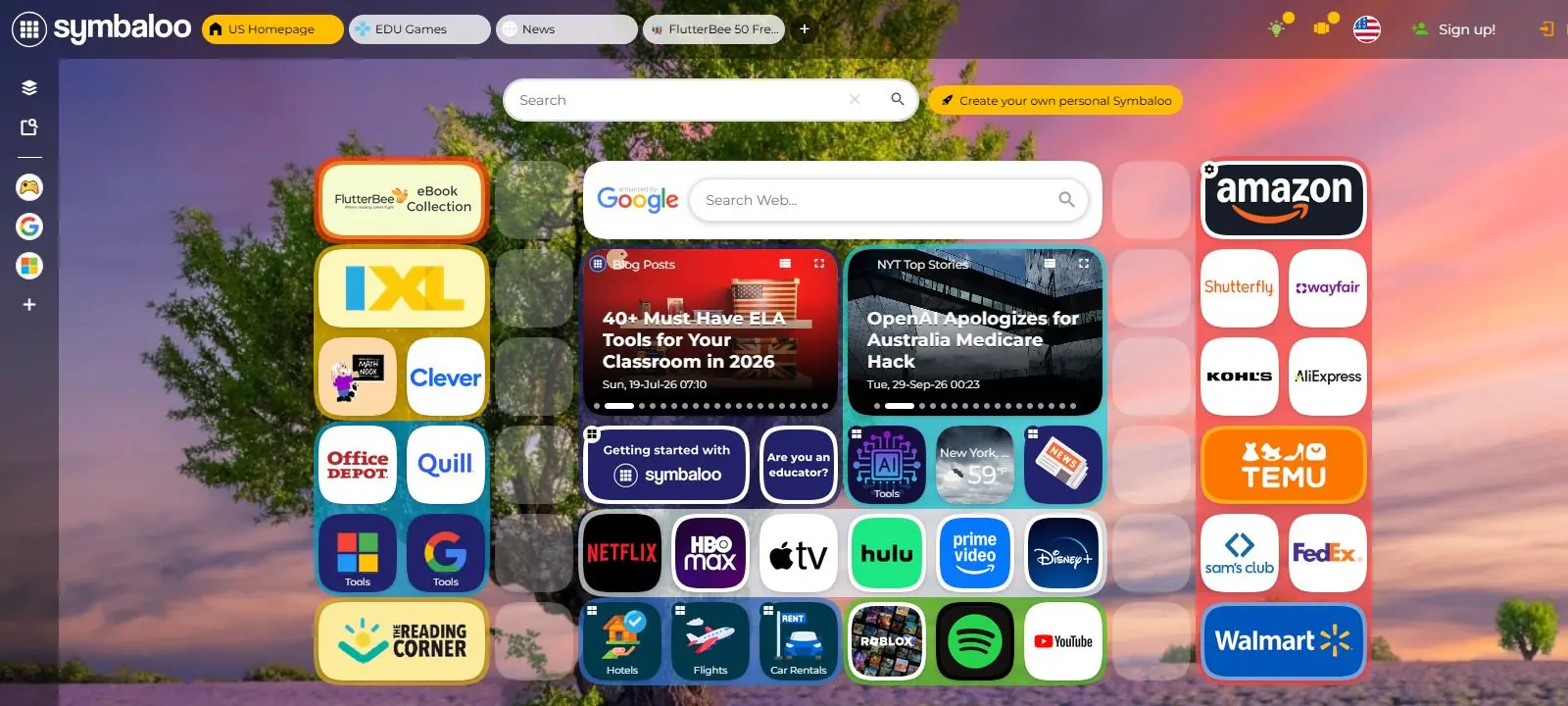
Symbaloo is a hosted start page built around a single idea: bookmarks as colored tiles, arranged into collections it calls "webmixes." You sign up, add links as tiles, group them however you like, and can set the result as your browser's homepage. Symbaloo's own blog describes it as "the #1 Homepage and Bookmark Manager" and claims "over 25 million users worldwide" (blog.symbaloo.com, read 2026-09-29); that figure is the company's own, not an independently verified count.
The product splits into two very different audiences. A personal user gets the Free plan or Personal Premium, described on Symbaloo's own homepage as a way to "save, organize, and share your favorite links in one place" and to set a personalized start page. Everything above that, Classroom, Library, and Schools & Districts, is priced and built for education: child-safe mode, COPPA compliance settings, and centralized device management for a school or district (symbaloo.com/plans, read 2026-09-29). If you're looking for a personal bookmark grid, you're using a small corner of a much larger product built mainly for teachers and schools.
Features worth knowing
Webmixes are the core organizing unit: a grid of tiles you can create as many of as you like, each one linking out to a site, document or video. Tiles can be recolored, given custom icons, or grouped into folders, and a whole webmix can be shared by private link, published to a Symbaloo Webspace, posted to the Symbaloo Library, or shared on social media (symbaloo.com, read 2026-09-29).
The Symbaloo Library holds what the site calls "more than a million user-created Webmixes," including a large set of curated "best websites" collections aimed at classrooms, covering subjects like coding, ELA, math and social studies (symbaloo.com/library, read 2026-09-29).
Two separate browser extensions cover different jobs. The Symbaloo Bookmarker adds a page to a webmix while you browse, without leaving the page. The Symbaloo Homepage & Search Extension sets your browser's homepage and new tab, and lets you search the web through Symbaloo when you open a new tab. Both are available for Chrome, Firefox and Edge (blog.symbaloo.com, read 2026-09-29).
If you already have bookmarks saved elsewhere, Symbaloo's account settings include a bookmark importer: export an .html bookmarks file from Chrome, Firefox, Safari or Edge, then import it directly (blog.symbaloo.com, read 2026-09-29).
Getting started
Sign up for free at symbaloo.com, then start adding tiles to build your first webmix. To make Symbaloo your actual browser homepage, use the site's own "Set as Homepage" option, or install the separate Homepage & Search extension from the Chrome Web Store, Firefox Add-ons or Microsoft Edge Add-ons for deeper new tab integration (symbaloo.com, read 2026-09-29). No account is needed just to browse the Symbaloo Library's public webmixes.
Pricing (checked 2026-09-29)
Free works with advertising shown across your webmixes. Personal Premium removes that advertising for $34.95 a year or $4.49 a month; Symbaloo's own copy for the upgrade reads "Upgrade to remove advertising and unlock powerful new features that enhance customization and sharing your favorite content with family and friends" (symbaloo.com/plans, read 2026-09-29).
Above Personal Premium sit three institutional plans priced by usage rather than by individual account: Classroom at $69 a year, Library at $699 a year, and Schools & Districts starting at $999 a year. Each is billed on a pool of "ad-free Webspace pageviews," a metric about how many visits a school's published, public-facing Webspace can take before showing ads again, not about your own personal tile grid. A personal account never touches that metric at all (symbaloo.com/plans, read 2026-09-29).
Limits and trade-offs
Most of what Symbaloo builds is aimed at education, not personal use. Its pricing ladder tops out at a $999-a-year district plan, its blog's own content leans heavily toward teacher and classroom guides, and features like child-safe mode and COPPA compliance only make sense for a school. A personal user is choosing between exactly two options: free with ads, or $34.95 a year without them.
It's closed source, with no published repository or license, so there's no way to audit how your tiles or account data are handled beyond Symbaloo's own privacy policy. There's no dedicated iOS or Android app either; the "Install Symbaloo App" option on its homepage installs it as a browser-based web app through your browser's own PWA support, not through an app store listing.
The claimed "25 million users worldwide" figure comes from Symbaloo's own marketing copy. There's no independently published number to check it against, and no way to tell how many of those accounts are personal users rather than students given a school-issued login.
Alternatives
- start.me, bookmark-based rather than tile-based, with a Personal PRO tier that unlocks more widgets rather than just removing ads.
- Protopage, a free widget-based start page with private, public or password-shared tabs.
- igHome, an iGoogle-style portal of gadgets, bookmarks and news feeds with no account wall.
- Abunch, organizes links into public or private categories rather than tiles, with a much cheaper premium tier.
- MyKK, open source and free, distributed as a single downloadable HTML file rather than a hosted account.
Questions people ask
How do I find my homepage?
On Symbaloo, your homepage is whichever webmix you have set with the site's own "Set as Homepage" option, found in your account after signing in. If you are not sure what your browser's homepage is currently set to, check your browser's own settings page for new tabs or startup pages; that setting is what Symbaloo's homepage extension and "Set as Homepage" link both write to.
Sources
- symbaloo.com, read 2026-09-29
- symbaloo.com/plans, read 2026-09-29
- blog.symbaloo.com, read 2026-09-29
- symbaloo.com/library, read 2026-09-29
Last checked 2026-09-29.
Last checked